Driving Yourself to See the Northern Lights: Safe Routes, Tips, and Mistakes to Avoid (Iceland 2026 Guide)
How to Plan a Safe Self-Drive Northern Lights Chase
Safety Tips for Winter Driving in Iceland
Common Mistakes To Avoid
When You Should NOT Drive Yourself
Start Your Northern Lights Night at Aurora Reykjavík
The simple answer: Yes — but only if you prepare well.
Every winter, thousands of visitors in Iceland choose a self-drive northern lights chase. It gives you freedom, flexibility, and the magic of experiencing the aurora in complete silence.
But Iceland’s winter roads can be snowy, windy, icy, and unpredictable, so planning is essential. This guide walks you through safe driving routes, real local tips, what NOT to do, and how to increase your chances of seeing the lights.
How to Plan a Safe Self-Drive Northern Lights Chase
Step 1 – Check the Weather and Cloud Forecast
Clear skies matter more than anything. Before driving, always check:
- Cloud map (low, mid, high clouds)
- Wind speed — anything above 15–18 m/s can be dangerous
- Road conditions (rockfalls, ice, snow, closed roads)
- Warnings from the Icelandic Met Office
💡 At Aurora Reykjavík, we combine Iceland’s cloud forecast with real space-weather data. Check our updated Northern Lights Forecast before you go.
Step 2 – Choose Safe and Accessible Routes From Reykjavík
Here are the best self-drive northern lights locations, all within 20–60 minutes of Reykjavík and with relatively safe access.
Route A – Seltjarnarnes / Grótta Lighthouse (20 minutes)
- Closest dark-sky area to Reykjavík
- Flat, easy roads
- Perfect for a short evening drive
- Great for families
👉 If clouds move in, return to Reykjavík and visit Aurora Reykjavík, Iceland’s only place to see the Northern Lights guaranteed all year.
Route B – Þingvellir National Park (45 minutes)
- One of the darkest and quietest locations
- Wide viewpoints and safe parking
- Avoid the steep side roads — stay on the main route
⚠️ Watch for icy patches and drifting snow on the final stretch.
Route C – Mosfellsdalur Valley (25 minutes)
- Close, sheltered, easy winter drive
- Fewer tourists
- Beautiful mountain silhouettes for photography
Route D – Reykjanes Peninsula (40–50 minutes)
-
- Excellent visibility toward the ocean
- Little light pollution
- Combine with geothermal areas like Gunnuhver
⚠️ Storm-prone area — only go when wind is low. The peninsula can become extremely windy with little warning.

Northern Lights over the South Coast
Safety Tips for Winter Driving in Iceland
1. Slow Down — Ice Isn’t Always Visible
Black ice is common, especially after sunset.
Drive slower than you would expect and keep a safe distance.
2. Never Stop in the Middle of the Road
This is the most common mistake tourists make.
Always use official parking areas or wide lay-bys.
Stopping on the roadside in the dark is extremely dangerous.
3. Bring a Fully Charged Phone + Power Bank
Cold weather drains batteries quickly.
Download offline maps in case you lose signal.
4. Watch the Wind
In Iceland, wind is often more dangerous than snow.
If your car door is hard to open — go home.
If you see blowing snow across the road, turn back.
5. Dress for Arctic Conditions
You may stand outside for long periods:
- Wool base layers
- Down jacket
- Gloves + hat
- Waterproof boots
6. Don’t Chase “KP Numbers” While Driving
KP Index is NOT what determines visibility in Iceland.
Clouds matter more — and KP 2–3 is usually enough.
👉 Learn the easy way to read aurora data on our Forecast Page.
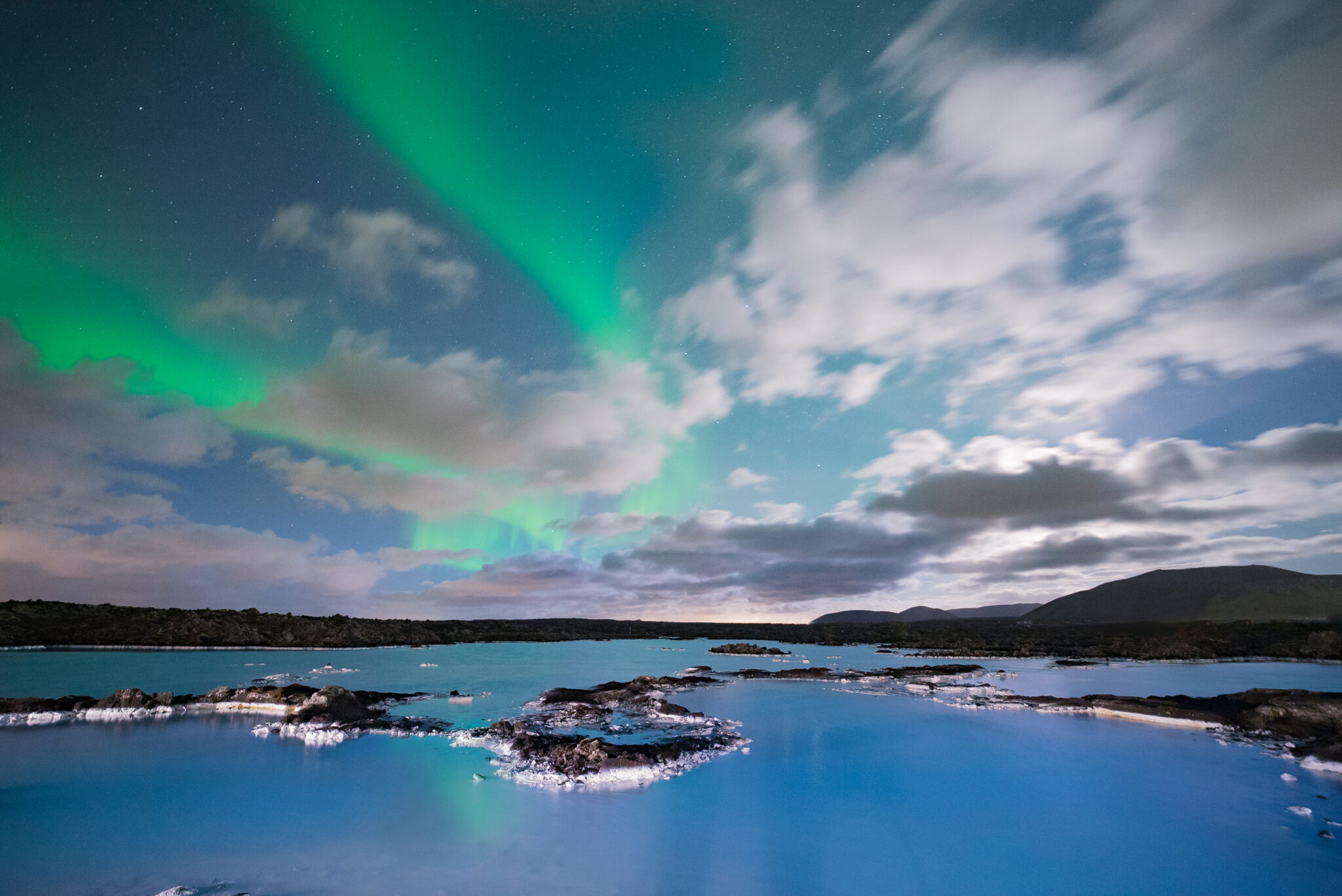
Northern Lights over the Blue Lagoon
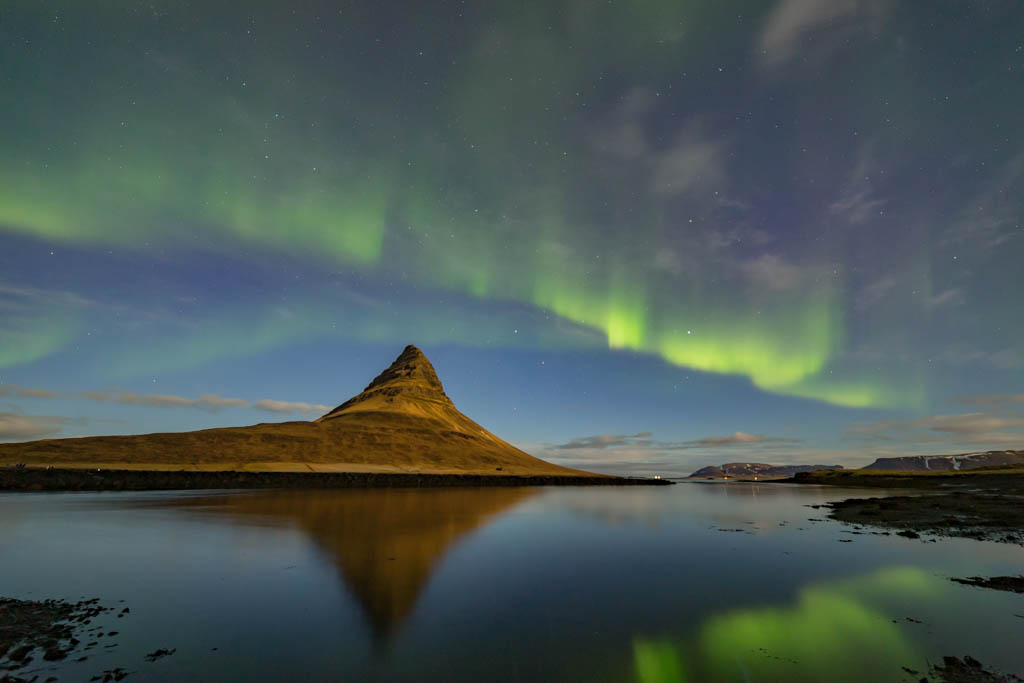
Northern Lights with ocean view
Common Mistakes First-Time Aurora Drivers Make (and How to Avoid Them)
❌ Mistake 1 – Driving Too Far
If the aurora appears while you drive, you might miss the show.
Choose a few nearby safe spots instead of long distances.
❌ Mistake 2 – Relying Only on Instagram Spot
Many “secret places” online are dangerous, dead ends, or private property.
Stick to official viewpoints.
❌ Mistake 3 – Forgetting About Moonlight
The moon can brighten the sky — but it also creates beautiful contrasts.
Don’t cancel a chase just because the moon is full.
❌ Mistake 4 – Giving Up Too Early
Auroras come in waves.
If there’s a break in the clouds, stay at least 20–30 minutes.
When You Should NOT Drive Yourself
There are days when self-driving is not a good idea:
- Yellow or red weather warnings
- Winds over 20–25 m/s
- Freezing rain
- Road closures
- Poor visibility from blowing snow
On those days, join a Northern Lights Tour instead — professional drivers know safe routes and conditions.
👉 Check out our Northern Lights Tours selection
👉 Our team at Aurora Reykjavík works with the best and safest tour companies in Iceland.
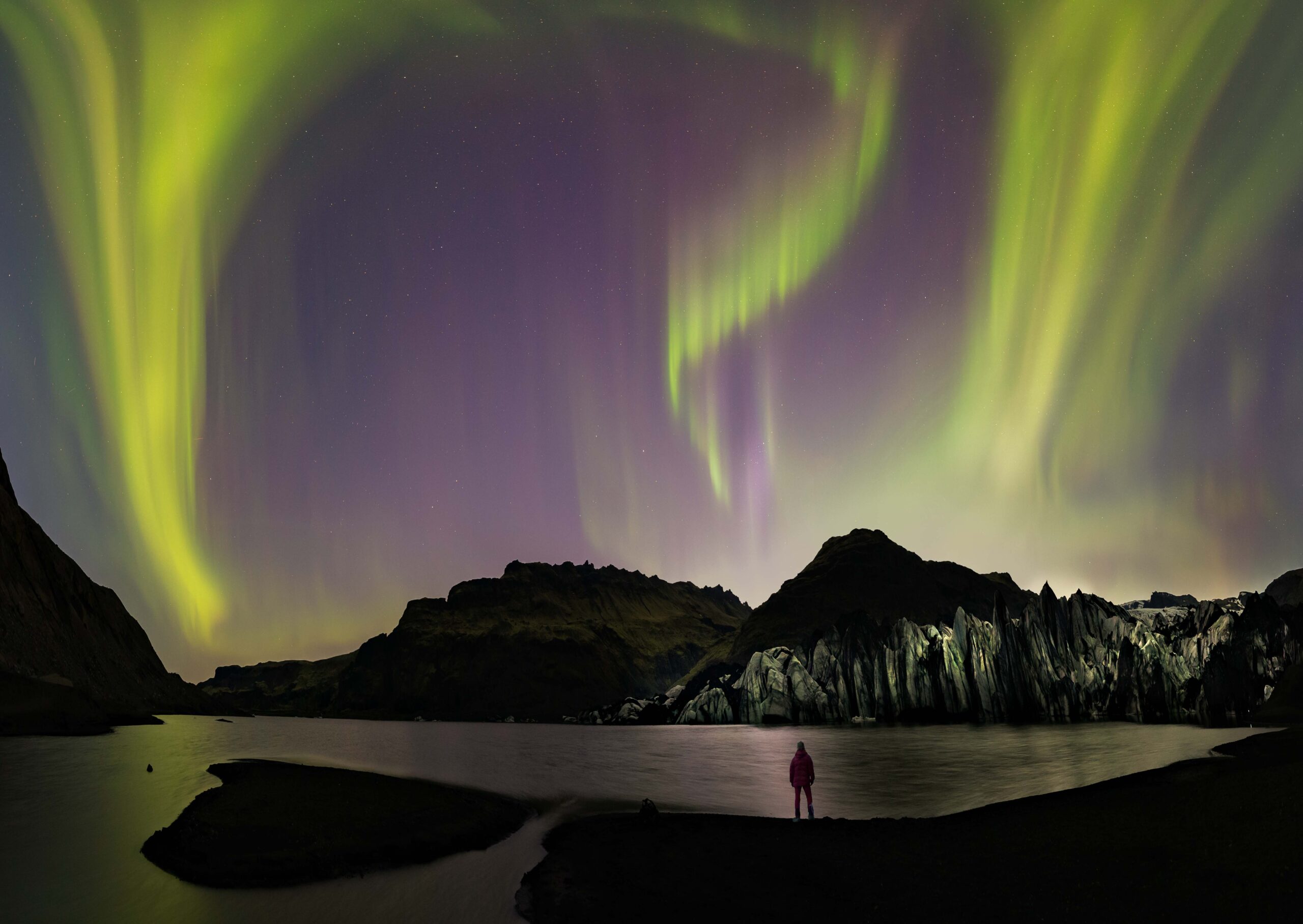
Aurora Expert Grétar Jónsson, owner and CEO of AURORA REYKJAVÍK capturing the Northern Lights at Sólheimarjökull, Iceland
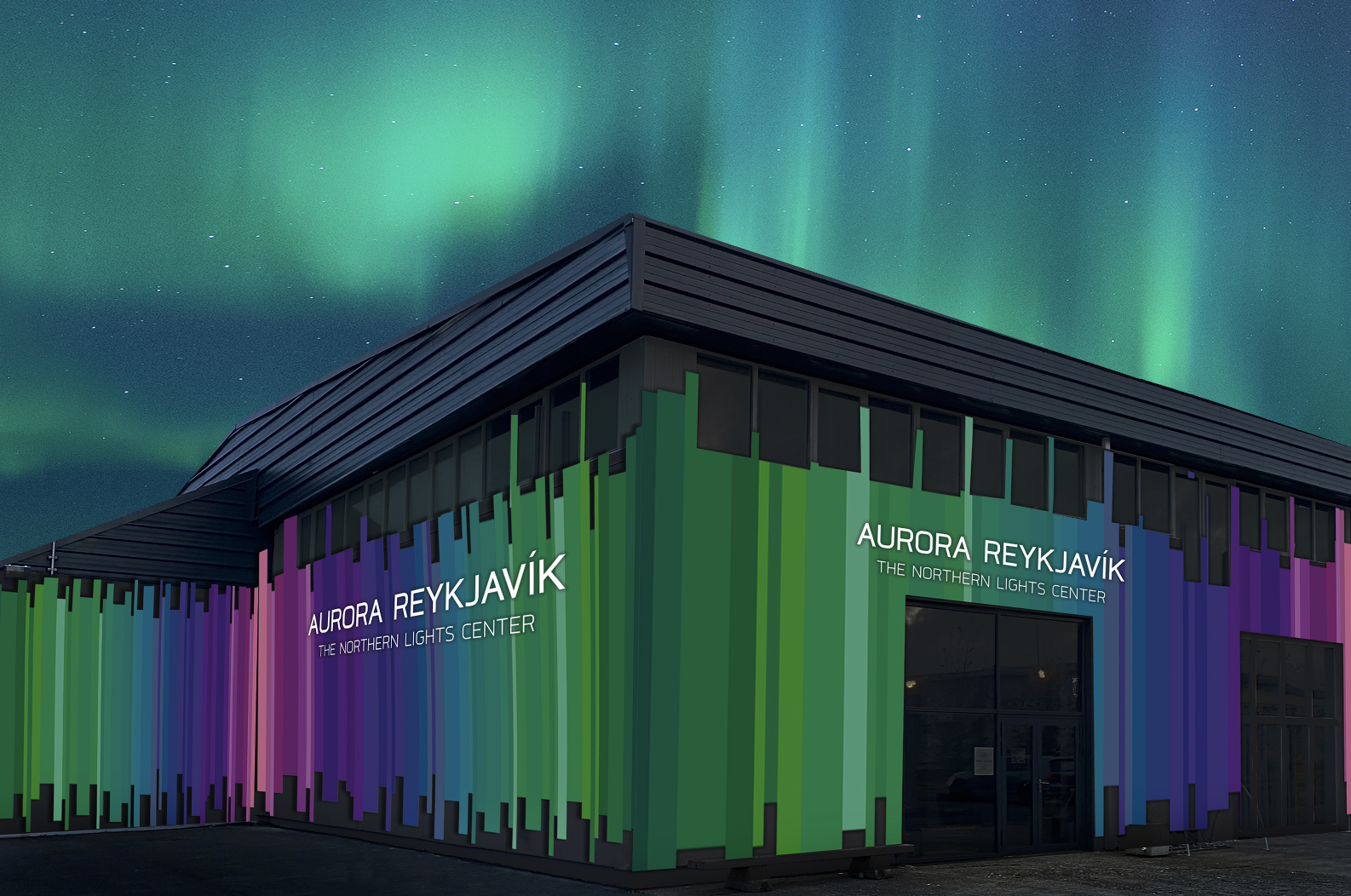
Northern Lights above Aurora Reykjavík
Start Your Northern Lights Night at Aurora Reykjavík
✔ Live aurora forecasts
✔ Expert tips from real Northern Lights hunters
✔ Photo training in our Aurora photography room
✔ A guaranteed Northern Lights experience in case the weather changes
👉 Book your ticket here
👉 Open every day – perfect warm-up before heading into the dark.
Conclusion
Self-driving to see the Northern Lights in Iceland can be magical — if you choose safe routes, check the weather carefully, and avoid common mistakes. With the right preparation, your Northern Lights chase will be one of the most unforgettable nights of your trip.
And if the weather doesn’t cooperate?
Aurora Reykjavík is the only place in Iceland where you can see the Northern Lights every day of the year.
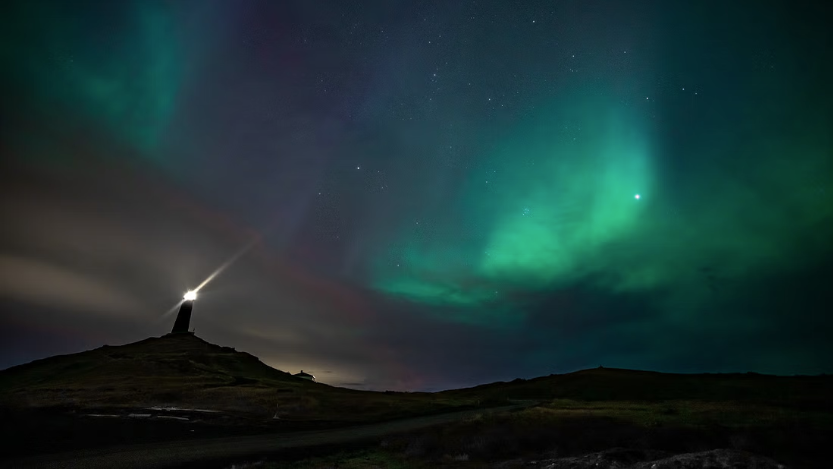
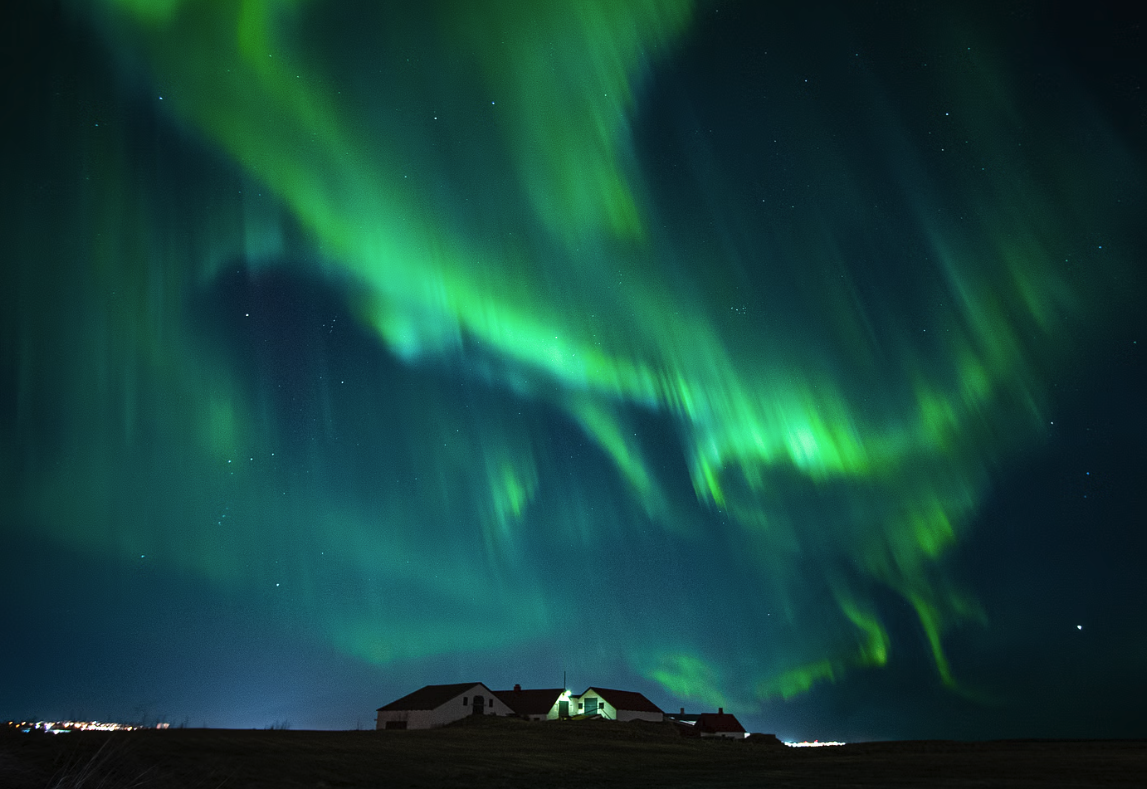
Green northern lights and stars over a hill, with lighthouse in backdrop
Join us on a guided Northern Lights Tour
Skip the stress of winter driving in the dark and join a group of like-minded adventurers on a guided Northern Lights hunt.
FAQ about the Northern Lights
When can I see northern lights in Iceland ?
The northern lights season in Iceland begins in late August and continues through mid/late April.
During this long period, Iceland experiences sufficient darkness for the Aurora to be visible at night.
However, chances of experiencing the northern lights vary depending on the time of year. Find out which months are the best for seeing the Aurora here.
Why can't I see any northern lights in the summer ?
To be able to see the northern lights you need sufficient darkness. During summer we have what we call the “midnight sun”, meaning that there are no hours of actual nighttime darkness. These conditions are perfect for late night hiking and exploring, but make it impossible for us to observe the Aurora in Iceland between May and early August.
Want to know more about light conditions in Iceland? Check the sun graph and learn about twilight and dusk in Iceland.
What time do the northern lights show up?
Northern lights are statistically often seen between 9:00pm and 1:00am, but they may appear at any time as long as it is dark (and the sky clear).
During the winter months, when the hours of light are limited, the northern lights can often appear as early at 7:00pm.
As the exact time of an Aurora display cannot be predicted, keep your eyes at the sky. And remember, patience is key!
How long do the northern lights last?
Auroras can last any time between few minutes and hours.
Each northern lights display is different, and varies in duration. Furthermore, the northern lights are not always visible for the entire duration of a single Auroral episode: they often change in intensity throughout a single display, and can go from very bright to incredibly faint, to the point they are hardly visible at all any more.
Learn more about how the northern lights behave duration-wise here.
Can I see the northern lights when it is cloudy?
Well, that depends. First of all, Iceland is well-known for its unpredictable weather: the fact that it is cloudy now does not mean that the sky will still be cloudy 5 minutes from now.
As long as we can find some gaps in the cloud cover, some windows of clear sky – there’s hope.
And, even when it’s cloudy, keep in mind that not all clouds are the same. For example, high clouds are often see-through and do not necessarily disrupt our view. Rule of thumb: if you can see the stars, you can potentially see the northern lights too.
Once again, keep your eyes at the sky and check the forecast regularly for the most reliable prediction.
Do the northern lights only appear when it is cold?
The northern lights season in Iceland starts in late summer.
As you can imagine, this means that you don’t need cold temperatures to see an Aurora (although you should not expect t-shirt weather at night in Iceland, not even in August).
The northern lights happen way above the weather systems, and are not influenced by weather systems and temperature fluctuations in the lower atmosphere.
Find out more here.
Are the northern lights visible all over Iceland?
Iceland is located within the so called “aurora belt“, the area where the northern lights are typically seen.
In the Arctic region, the belt extends between 60°N and 70°N latitude. As Iceland in its entirety is included between 63°N and 67°N, and therefore well within the aurora belt, chances of seeing the northern lights are virtually the same everywhere around the island – if weather allows.
That said, the likelihood of witnessing the northern lights is higher away from the city lights, and some areas around the country are especially scenic. Here are our favourite locations for northern lights spotting in Iceland.
Are the northern lights really colourful?
The northern lights happen in a variety of colours. Green is by far the most common, but the Aurora can also appear in vibrant shades of pink, purple, red, violet and blue.
To the naked eye though, the northern lights can look quite faint, and at times be perceived as white or grey-ish. This is due to limitations in our night vision.
Camera devices instead can capture a more truthful version of the colours, as, in most cases, it possible to adjust the device settings in order to better adapt to the night time conditions.
Find more about how to improve your night vision and learn how to take great Aurora shots here.
Are the northern lights going to disappear in future?
No, the northern lights are not going anywhere!
The Aurora has been visible in the Arctic for centuries, and that is not going to change any times soon.
What is true is that the solar activity, which is responsabile for the occurrence of the northern lights on our planet, changes over time, following an eleven-year cycle.
During each solar cycle, the Sun goes from a peak to a minimum of activity. During the peak, the so called “solar maximum“, we can expect enhanced activity and, potentially, stronger northern lights visible from unusual latitudes (in the northern hemisphere, this means Auroras being spotted further south than usual). While, during the solar minimum, such unusually strong occurrences become rarer.
Still, at Arctic latitudes the northern lights can be see clearly throughout the whole cycle. And Iceland, being well within the “Aurora belt”, is and will remain the perfect destination for northern lights hunting!
What is the BZ value?
The Bz value is part of the Interplanetary Magnetic Field (IMF), which is the magnetic field carried by the solar wind coming from the Sun.
Why does it matter for the Northern Lights? Earth’s magnetic field points north. If the solar wind’s magnetic field (Bz) points south (a negative Bz), it connects with Earth’s field and lets charged solar particles into the atmosphere. This interaction helps create the northern lights. If instead, Bz is positive (northward), the fields don’t connect well, and fewer particles get in — meaning weaker or no aurora.
Think of Bz like an ON/OFF switch: negative Bz (south) = ON, good chance of Aurora soon. Positive Bz (north) = OFF, Aurora less likely.
Learn more about Bz and how the forecast works here.
Which are the best forecast apps and websites for Northern Lights hunting?
Which are the best forecast apps and websites for northern lights hunting?
Chasing the Northern Lights is all about timing, clear skies, and up-to-date aurora forecasts. These tools help you know when and where there’s a good chance of seeing the aurora — so you can plan your night the smart way. For the best results, we recommend using more than one source, as different forecasts interpret data differently.
WEB FORECASTS
- Official AURORA REYKJAVÍK Aurora Forecast 👉 https://aurorareykjavik.is/aurora-forecast/
Our 6-step expert forecast combines geomagnetic activity, cloud cover, and viewing tips — designed for real-time Northern Lights planning. - SpaceWeatherLive
A detailed global space weather site with auroral activity maps and solar parameters. - NOAA Space Weather Prediction Center (SWPC)
The official US space weather forecast model that many aurora apps base their data on.
TOP MOBILE APPS
- My Aurora Forecast – Offers real-time KP index, global aurora maps, push alerts and multi-day forecasts — great for travelers and serious aurora watchers alike.
And don’t forget to unable notifications, so you’ll get alerts when aurora activity spikes.
📍App Store
📍 Google Play
By following this guide, you’ll be well-prepared to experience one of nature’s most magical displays. Whether you’re planning your trip or already in Iceland, the Aurora awaits!