Northern Lights Forecast Iceland Tonight
Live Aurora Forecast for Reykjavík & Iceland
Tonight's Northern Lights Forecast · Reykjavík & Iceland
MODERATE CHANCES TONIGHT
- Clouds · Greater Reykjavík
- Patchy skies over the area, with pockets of clarity over parts of West and South Iceland.
- Solar activity
- Kp 3 expected.
- Best viewing time
- 21:00–01:00
- Next days
- Cloud cover limited mostly to high clouds, often see-through. Stable solar activity.
Our take: Fast changing cloud conditions make for an unpredictable evening - patience is key! Maximise your chances by checking the cloud forecast below later in the day and before heading out, or joining a northern lights tour.
Check cloud cover to find clear skies. Use the time slider to track changes. Darker, denser color = more cloud cover. Lighter, whiter areas = clearer skies — your best bet for tonight.
Aurora Reykjavík - The Northern Lights Center is the first, and only, museum in Iceland fully dedicated to the Northern Lights. Founded and run by passionate aurora experts, astrophotographers, and guides with decades of chasing the lights across Iceland.
Watch the sky over Iceland right now, streaming year-round from two locations — the only Iceland aurora forecast with a live camera built in.
See nothing but darkness? Come back once the sun has set.
REAL-TIME NORTHERN LIGHTS FORECAST
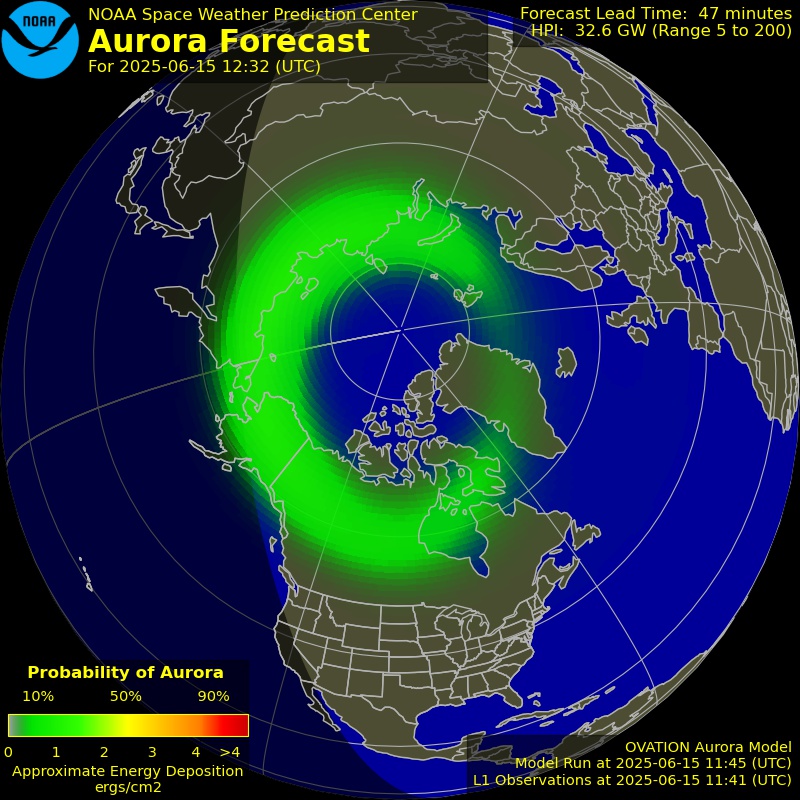
Live imagery straight from NASA and NOAA satellites — the same raw data our forecasters watch to judge tonight's chances.
NASA SDO/HMI · dark spots mark magnetically active regions, the source of flares and CMEs.
NOAA GOES-19 SUVI, 131 Å · bright flashes are flares — sudden bursts of energy from the Sun.
NASA SDO/AIA, 193 Å · dark patches vent fast solar wind that often fuels strong aurora nights.
NASA/ESA SOHO LASCO C3 · streaks show plasma clouds hurled outward — the biggest driver of major storms.
Measured ~1 million miles upwind of Earth by NOAA's SOLAR-1 spacecraft, shown at each reading's predicted Earth arrival time.
The EARTH line marks right now. Solid = already arrived. Dashed = already measured at SOLAR-1, still inbound.
Green = pointing north, red = pointing south. Southward Bz is what opens the door for aurora.
How to Read the Live Data
This is the same data our guides watch every night. It looks technical at first, but each number answers one simple question — here's how to read it, in order.
A single number from 0 to 9. Think of it as the headline number: the higher it is, the stronger and further south the aurora can reach.
Good sign: Kp 2 or higher usually means visible lights somewhere in Iceland.
Measured in km/s. Faster solar wind hits Earth's magnetic field harder, which tends to produce brighter, faster-moving auroras.
Good sign: speeds above 400 km/s.
Measured in particles per cm³. On its own, density doesn't do much — but combined with high speed and a southward Bz (see below), higher density can mean a more intense, energetic display. Think of it as fuel, not the spark.
Measured in nT. This is the total strength of the magnetic field the solar wind is carrying. A stronger Bt makes everything else more effective, but only if Bz (next) is pointing the right way.
Good sign: Bt of 6 nT or higher, combined with a southward Bz.
Measured in nT, either northward (positive) or southward (negative). This is the one that decides whether everything else even matters: a southward Bz opens a "door" in Earth's own magnetic field, letting solar particles in to create the aurora. A northward Bz keeps that door mostly shut, even if every other number looks great.
Good sign: Bz at –2 nT or lower (southward). Ideally –3 nT or below.
Put simply: check Bz first — it decides if the door is open. Then Kp tells you how strong the storm is, and speed, density, and Bt tell you how much punch is behind it. Combine all of this with clear skies and real darkness for your best chance of actually seeing it.
参加我们的极光之旅
超级吉普车极光之旅
4.9
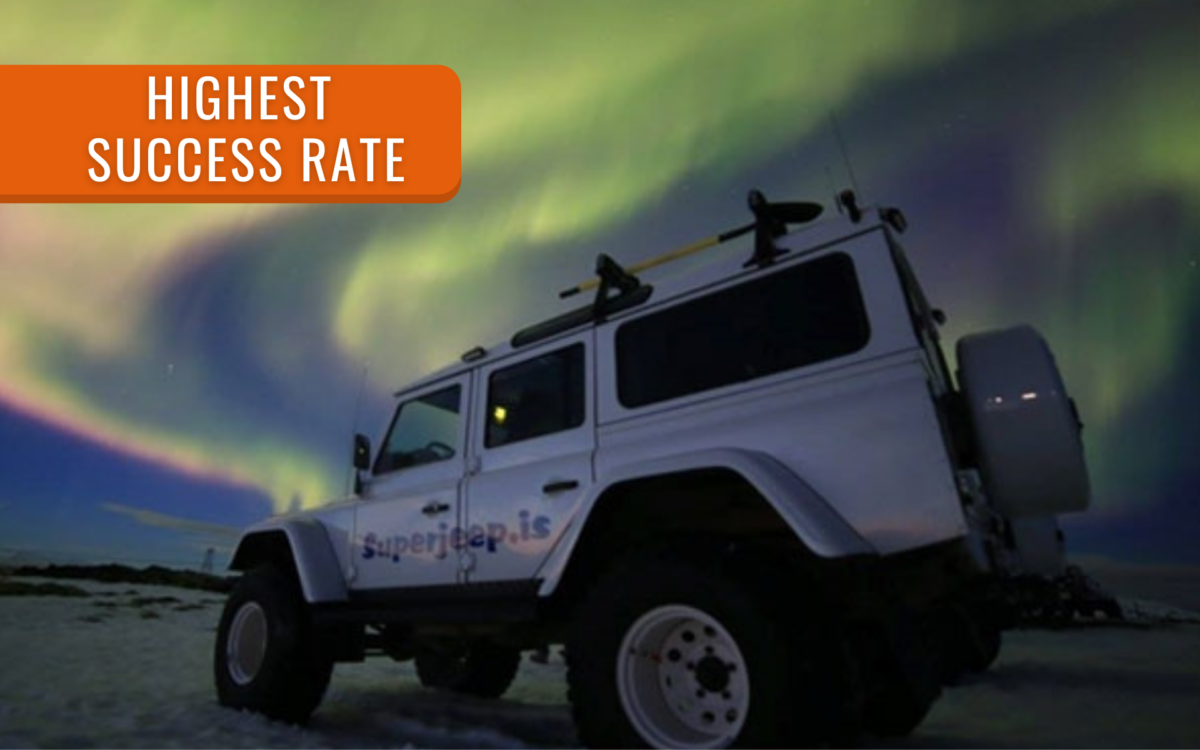
跟着专业极光猎人,乘坐超级吉普出发追光!精品小团出行,越野座驾直抵荒野深处,寒夜里还有一杯暖心热巧克力相伴,更有免费极光纪念照,为你定格人生高光时刻。冰岛成功率最高的极光超级吉普之旅,另含 Aurora Reykjavík 极光中心门票,一次体验,双重收获!
组合优惠:黄金圈,蓝湖温泉和北极光之旅
4.9
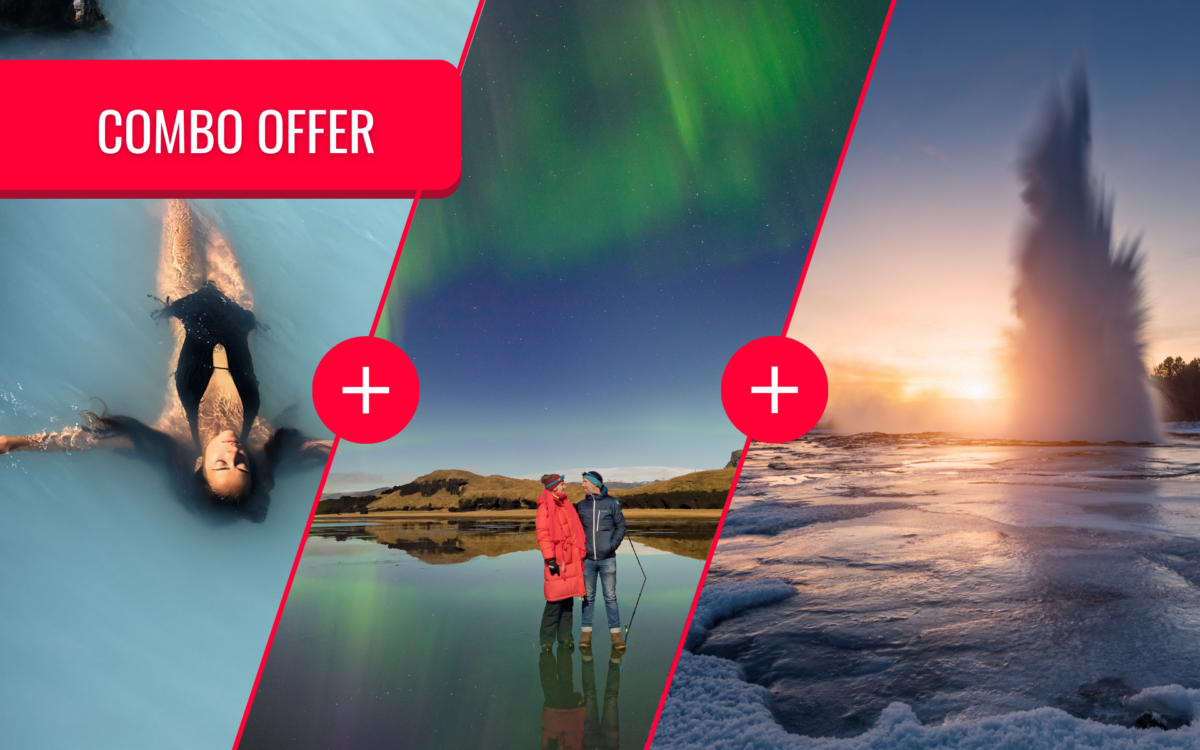
探索冰岛著名的黄金圈,畅泡蓝湖温泉,感受乳蓝色温泉水带来的惬意放松,夜晚再踏上追寻北极光之旅! 一次精彩的小团组合之旅,带您畅游冰岛最具代表性的热门景点,在充实而精彩的一天中尽享冰岛魅力!
排名第一的北极光小巴之旅
4.9
加入冰岛评分最高的北极光小巴之旅,最大程度提高邂逅极光的机会!专业极光向导全程陪同,如未能成功观赏极光,可免费再次参加行程,还可获赠与北极光的合影照片,以上服务全部包含在内!
北极光私人专属之旅(含专业摄影服务)
4.9
参加专属北极光私人定制之旅,亲眼见证令人惊叹的极光奇景! 在专业北极光摄影师兼私人向导的陪同下,开启专属极光追寻之旅。全程享受高品质交通服务、灵活自由的行程安排,还可免费获赠专业拍摄的北极光美照。 一场独一无二、令人终生难忘的极光体验,正等待着您!

小团体北极光私人定制之旅
4.8
在私人向导的带领下,开启精彩的北极光追寻之旅! 这趟专属小巴之旅最多可容纳18人,非常适合亲友团体或小型团队参加。 远离拥挤的人群,享受更加私密、舒适且个性化的极光观赏体验。行程还包含北极光摄影服务及暖心饮品,让您的追光之旅更加难忘!
团体专属极光私人之旅
4.7
与亲友或团队一起,开启独一无二的北极光探险之旅! 这趟专属北极光私人定制之旅专为大型团体设计,最多可容纳52位乘客,让您与团队共享难忘的追光体验。 远离拥挤人群,在专业向导的带领下,前往理想的极光观赏地点。行程包含专业向导服务、免费北极光摄影及暖心饮品,让您的追光之旅更加舒适惬意!
CHASING THE NORTHERN LIGHTS – A STEP-BY-STEP GUIDE FOR YOUR AURORA HUNT
Plan your Northern Lights hunt with Iceland’s most complete aurora forecast. A clear 5-step guide combining KP index, solar activity, cloud cover, and the best locations to watch the aurora.
01
Choose Your Dates
Two windows matter most when planning an aurora trip to Iceland: the 27-day Kp outlook, and the moon phase.
The 27-day Kp forecast: the Sun rotates once every 27 days, so the same active regions can swing back into view and reappear as similar geomagnetic activity a month later. That gives a rough, genuinely useful sense of aurora chances weeks ahead — not a precise prediction, but a real pattern worth planning a trip around. The bars in the chart below show forecast Kp for each of the next 27 days.
Timing within the season also matters. Around the spring and autumn equinoxes, Earth's magnetic field aligns in a way that makes it easier for solar wind to reach us — a well-documented pattern called the Russell–McPherron effect, making March and September consistently strong months for activity. Deciding between late winter and early spring? Compare what April offers against what March offers.
Moon phase: a bright full moon can wash out fainter auroras, though it also lights up Iceland's landscapes for striking photos. The dashed line in the chart shows moon illumination for each night, calculated automatically — no need to check a separate calendar. Read our full guide to auroras and the moon phases for how to time a trip around both.
Source: NOAA Space Weather Prediction Center, 27-day outlook. Moon phase calculated locally.
02
ESCAPE THE LIGHT POLLUTION
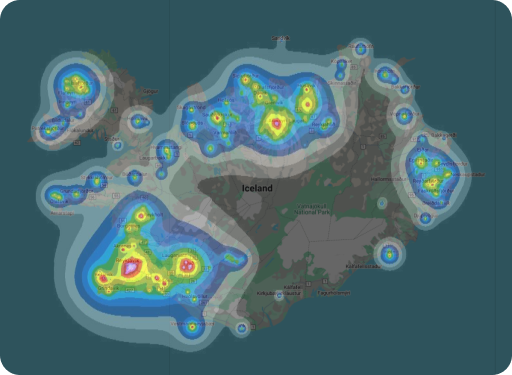
Darkness is non-negotiable. In Iceland, usable aurora darkness gradually returns during August and lasts until around mid-April. May, June and most of July are simply too bright. Once darkness returns, getting away from artificial light can make faint auroras much easier to see. Once you’re in that window, distance from artificial light matters as much as timing. See our full guide to the 25 best viewing locations in Iceland to find somewhere genuinely dark, not just “outside the city.”
Know the Live Tools Before You Need Them
Once you’re on the ground in Iceland, everything at the top of this page becomes your real-time toolkit: live Bz and solar wind data, the live cloud forecast map, and our live cameras. This step is just a heads-up — skim the “How to Read the Live Data” section near the top now, while you’re relaxed and planning, so on the night itself you’re reading conditions in seconds, not learning what Bz means for the first time in the cold and dark.
Pack Like You’ll Actually Be Standing Still in the Cold
Aurora hunting means standing still outside for long stretches, often well below freezing. Thermal base layers, a proper hat and gloves, and warm boots make the difference between an amazing night and a miserable one — see our recommended winter gear for Iceland for a full list. If you’re bringing a camera, a stable tripod and a wide-angle lens matter more than an expensive body — our full photography guide covers manual settings for both faint and bright displays. And bring patience: a hot drink and snacks go a long way through the waiting.
05
监测太阳活动
Chase It Yourself, or Let Us Point the Way
You don’t need to book a tour to get our help. Come by the museum before heading out, tell our guides what night you’re planning for, and we’ll advise you exactly where conditions look best — genuinely, whether or not you’re joining us. It’s the reason we opened in 2013: not to be your consolation prize if a self-guided hunt fails, but to be the reason it succeeds in the first place. If you’d rather not navigate dark, icy roads yourself, our guided tours do exactly what a solo chase can’t — real-time rerouting to clear skies, safety on the roads, and a guide who already knows tonight’s answer.
Peak forecast Kp for each day — the highest 3-hour window, since one active period can matter more than the daily average.
FIND AURORA TOURS
Everything on this page — Bz, Bt, solar wind, Kp — our guides watch it live, all night, every night. Knowing a number is favourable is different from knowing where that particular condition tends to produce results.
Cloud cover shifts across Iceland by the hour. Chasing alone means guessing and driving. Our guides track conditions across the whole island in real time and reroute the moment something better opens up.
Aurora hunting means driving unfamiliar roads in the dark, often on ice, then pulling over in unlit areas. Our vehicles and drivers are built for exactly this — you're free to focus on the sky, not the road.
Chase alone and a cloudy night is just a cloudy night. Most of our tours include a free re-run if the lights don't show — the kind of safety net a solo drive out into the dark can't offer.
常见问题
What Kp do I need to see the Northern Lights in Reykjavík?
Less than most people think. Reykjavík sits close to the auroral oval, so the Northern Lights can appear even at Kp 1–2 when the sky is dark and clear, although at low Kp they are usually faint and low on the northern horizon. From Kp 3 upward, displays get brighter and can be seen from the edges of the city. At Kp 5 and above, the aurora can spread across the whole sky, even overhead. In practice, clear skies and darkness matter more than the Kp number.
为什么极光预报会有变化?
还有其他极光数据来源我应该关注的吗?
极光指数有多准确?
在冰岛观赏极光的最佳月份是什么时候?
The Northern Lights season in Iceland runs from late August to mid-April. The darkest months, October through March, offer the longest viewing hours, but auroras can already be seen again once usable darkness returns in late August.
极光指数的高低在观赏极光方面有什么区别?
夏天能看到极光吗?
May, June and most of July are too bright for Northern Lights viewing because of Iceland’s midnight sun. Usable darkness gradually returns during August, and the Northern Lights season typically begins again in late August.
有哪些推荐的极光预报应用程式APP?
- My Aurora Forecast – 实时极光地图、27天预报和可自定义的提醒功能。非常适合初学者和经验丰富的极光追逐者。
- Aurora Alerts – Northern Lights – 实时提醒、云层覆盖图和极光指数读数。非常适合需要即时通知的你。
- Hello Aurora – 社区分享的目击信息、预报和实时条件。非常适合社交互动体验。
- Northern Eye Aurora Forecast – 详细的太阳风数据、极光指数和实时太阳活动更新。最适合科学爱好者。
- Aurora Forecast & Alerts – 按小时预报、云层地图和可自定义的通知。简单易用,便于快速获取更新。
在冰岛最佳的极光观赏之旅有哪些?
我可以在哪里了解更多关于极光的信息?
Which direction should I look for the Northern Lights in Reykjavík?
Start by looking north. On most nights the aurora appears as a band or glow above the northern horizon, so choose a spot with an open view in that direction, such as the sea at Grótta. During stronger activity the aurora can move overhead and even into the southern sky, so look up and around as well. Give your eyes 15 to 20 minutes away from screens and bright lights to adjust.
What time of night is best to see the Northern Lights in Reykjavík?
Activity often peaks between about 22:00 and 01:00, but the Northern Lights can appear any time it is dark enough, from late evening until shortly before dawn. The Sufficient darkness time in Today’s Outlook on this page shows the earliest time for tonight. A bright moon washes out faint aurora, so hours when the moon is down or low are best.
Where can I see the Northern Lights near Reykjavík?
You don’t need to go far. Grótta Lighthouse on Seltjarnarnes is one of the darkest spots inside the capital area and faces north over the sea. Kleifarvatn lake on the Reykjanes peninsula is about 30 minutes’ drive away, and Þingvellir National Park is about an hour. Strong displays can be seen from the city centre too, but street lights hide fainter aurora, so even a short drive out of town makes a big difference. Our guide to the 25 best places to see the Northern Lights in Iceland covers more spots.