BLUE LAGOON VS. SKY LAGOON : QUEL SPA ISLANDAIS CHOISIR ?
Avantages et rapport qualité-prix
Comparaisons rapides
Lequel choisir ?
L'Islande est célèbre pour ses bains géothermiques, et deux expériences de spa de classe mondialeattirent des visiteurs du monde entier. Dans cet article, nous comparerons l'emblématique Lagon Bleu avec le Lagon Céleste, plus récent mais très populaire : deux façons inoubliables de se détendre dans les eaux géothermales apaisantes d'Islande.
Aperçu : Les classiques contre les contemporains
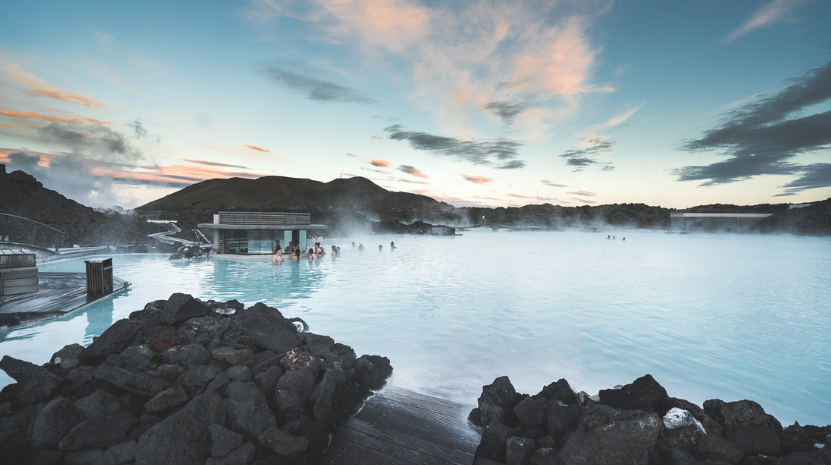
- The Blue Lagoon has been an Icelandic staple since the 1980s. Located in a geothermically active area and surrounded by ancient lava fields, this geothermal spa is known for its striking milky-blue waters rich in silica, algae, and minerals: elements said to have therapeutic benefits for the skin.
- Sky Lagoon, situé aux portes de Reykjavik, propose une vision novatrice de la tradition balnéaire islandaise. Son design et son expérience s'appuient sur le luxe moderne et un lien profond avec la culture du bien-être nordique, notamment grâce à un Rituel en 7 étapes inspiré des coutumes balnéaires locales.
Comparaison rapide : Lagon bleu vs. Lagon céleste
Le Lagon Bleu est le spa géothermique le plus célèbre d'Islande. Son ambiance emblématique, son immensité et son atmosphère conviviale le rendent particulièrement attrayant pour les visiteurs qui découvrent l'Islande et les familles. Il offre un vaste espace de baignade, des masques de boue de silice signature et de nombreux équipements, tels que des restaurants et même des hébergements de luxe sur place. Son emplacement au cœur d'un spectaculaire champ de lave crée une atmosphère surréaliste et irréelle que de nombreux voyageurs associent instantanément à l'Islande.
À l'inverse, le Sky Lagoon offre une expérience plus moderne et intime, axée sur la détente et le bien-être. Il est surtout réputé pour son expérience de bien-être immersive, qui combine thérapie par le chaud et le froid. Situé plus près de Reykjavik, le Sky Lagoon propose une piscine à débordement et un sauna avec vue sur l'Atlantique Nord, un cadre particulièrement mémorable au coucher du soleil.
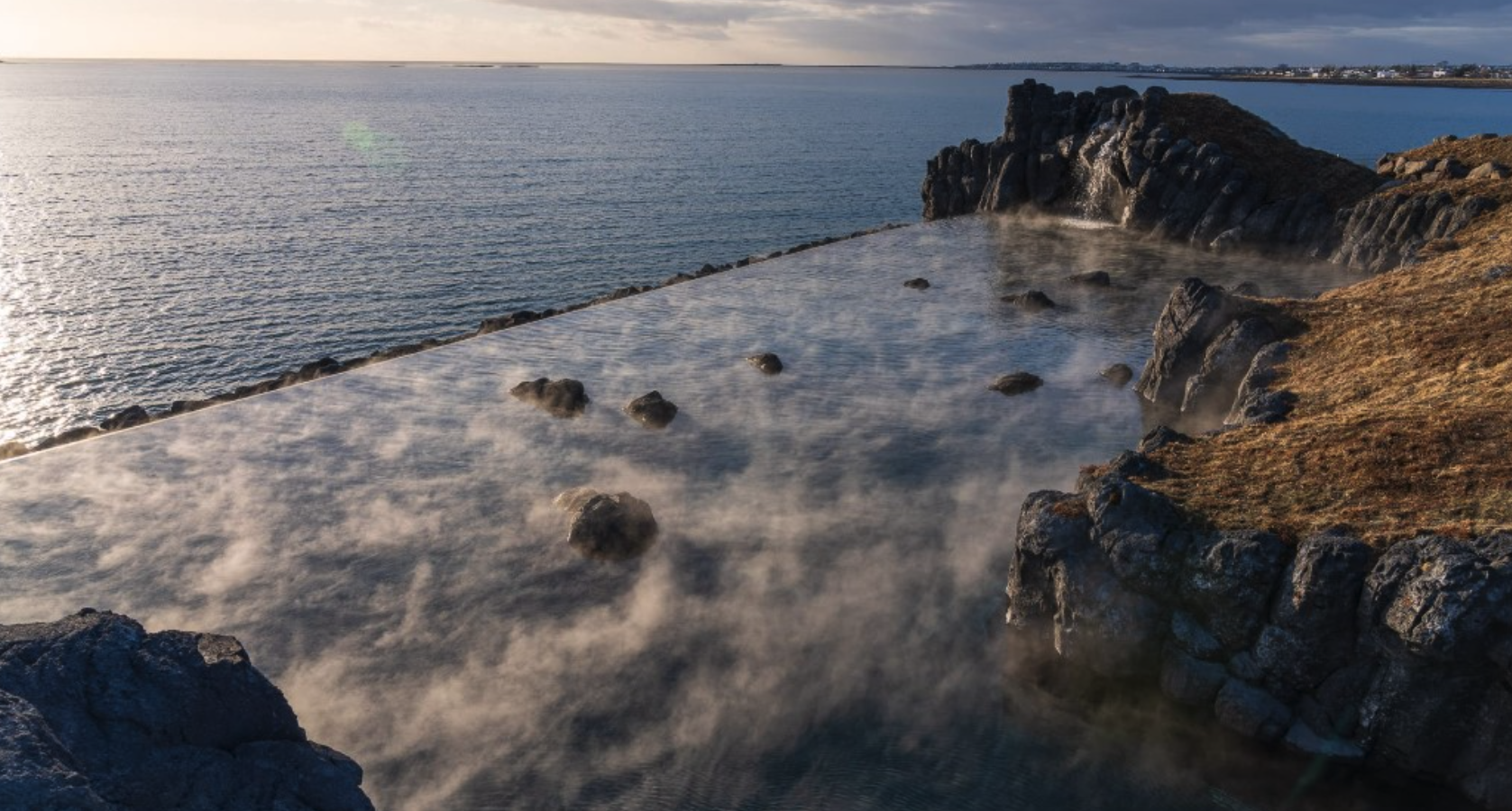
Piscine à débordement Sky Lagoon au bord de l'océan
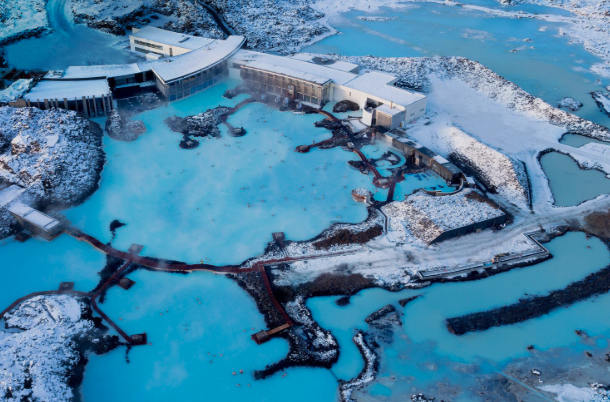
Aerial view of the Blue Lagoon
Expérience et atmosphère
Le Lagon Bleu
Chargée d'histoire et immédiatement reconnaissable, cette destination semble hors du commun. Entourée de champs de lave accidentés et d'un ciel immense, les eaux bleu laiteux du lagon sont chaudes toute l'année et parfaites pour un long bain relaxant.
Caractéristiques distinctives :
- Masque à la boue de silice inclus avec tous les billets.
- Une piscine plus grande surface totale (environ 8 700 m²) avec beaucoup d’espace pour se détendre.
- Options d'hébergement de luxe sur place pour une retraite bien-être exclusive.
- Plusieurs restaurants et expériences culinaires avec vue sur le lagon.
Sky Lagoon
Sky Lagoon privilégie l'immersion et la réflexion. L'expérience s'articule autour du Rituel Sky en 7 étapes, une séquence structurée de bains chauds, de bassins froids, de saunas, de hammams et bien plus encore. La conception à l'infini face à l'océan du lagon donne l'impression de se baigner au bord de l'Atlantique Nord, un spectacle particulièrement saisissant au coucher du soleil.
Caractéristiques distinctives :
- Le rituel en 7 étapes, un parcours de bien-être alternant expériences chaudes et froides.
- Vues imprenables sur l'océan depuis la piscine à débordement et le sauna face à l'océan.
- Un design nordique moderne qui met l'accent sur la sérénité et le lien avec la nature.
- Un aménagement de piscine légèrement plus petit mais intime avec des espaces variés à explorer.

Silica face masks at the Blue Lagoon
Prix et rapport qualité-prix : Blue Lagoon
Les forfaits incluent des avantages comme des masques en silice, des serviettes, des boissons, etc. Les forfaits premium peuvent se prolonger jusqu'à une journée complète de bien-être avec des extras.
Pourquoi choisir le Lagon Bleu ?
✔ Une expérience islandaise classique et emblématique
✔ Idéal pour une première visite et les familles
✔ Un espace plus vaste avec un plus grand choix de restaurants et d'hébergements
Prix et rapport qualité-prix : Sky Lagoon
Ce lagon propose souvent des formules tarifaires légèrement plus flexibles (y compris le rituel signature en 7 étapes).
Pourquoi choisir Sky Lagoon ?
✔ Une expérience de bien-être plus immersive
✔ Plus proche de Reykjavik
✔ Vues imprenables sur l'océan et magnifiques couchers de soleil
Conseil d'expert :La réservation à l'avance est fortement recommandée pour les deux, surtout pendant les mois de forte affluence, car les places se remplissent rapidement.
Choisissez un billet d'entrée pour Blue Lagoon ou Sky Lagoon avec transport depuis Reykjavik inclus pour une expérience sans tracas.

Une invitée profitant d'un bain au Sky Lagoon
Pourquoi ne pas choisir les deux ?
Si votre voyage le permet, combiner les deux vous offrira deux expériences de spa islandaises uniques : l’une ancrée dans l’histoire et le mystère géothermique, et l’autre axée sur le luxe et les rituels modernes.
Optez pour une excursion combinée, incluant une excursion d'une journée et une expérience spa, et profitez au maximum de votre séjour en Islande.
Nos excursions combinées recommandées pour le Lagon Bleu
- Visitez les principaux sites naturels d'Islande en une seule excursion pratique et rapide.
- Détendez-vous dans les eaux chaudes géothermiques du Lagon Bleu après une journée de visites.
- Profitez d'un voyage sans stress, avec transport, planification et entrée inclus.
- Plongez dans les eaux géothermales chaudes du Lagon Bleu, entouré par les paysages islandais.
- Partez à la chasse aux magnifiques aurores boréales avec des guides experts lors d'une excursion nocturne.
- Enjoy a seamless experience with transport and planning included.
Nos excursions combinées recommandées pour le Sky Lagoon
- Découvrez les sites emblématiques du Cercle d'Or en une excursion guidée d'une journée.
- Détendez-vous en profitant d'une vue imprenable sur l'océan depuis le balcon à débordement emblématique de Sky Lagoon.
- Enjoy a seamless experience with transport and planning included.
- Explorez les spectaculaires cascades, les plages de sable noir et les glaciers de la côte sud de l'Islande en une seule excursion.
- Détendez-vous en profitant de la vue sur la mer au spa géothermique à débordement de Sky Lagoon.
- Profitez d'une expérience sans tracas : le transport et la sont pris en charge.</span
Conseil d'expert :Vous prévoyez un court séjour le temps d'un week-end ? Découvrez notre itinéraire de deux jours, incluant une visite de nos lagunes géothermiques préférées.
Planifiez judicieusement votre visite : chaque lagon offre quelque chose de spécial, et tous deux révèlent la magie géothermique de l'Islande sous des angles très différents !
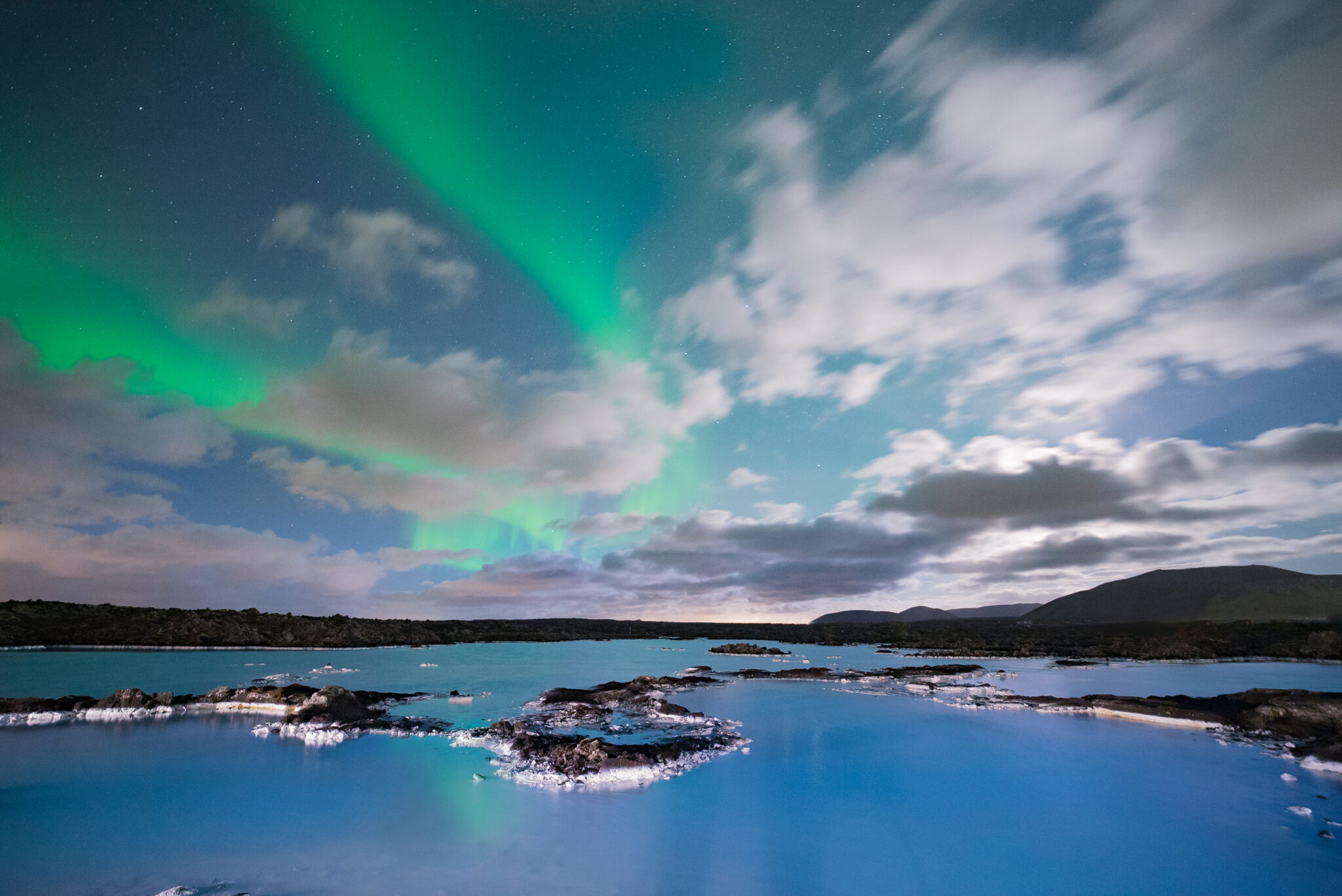
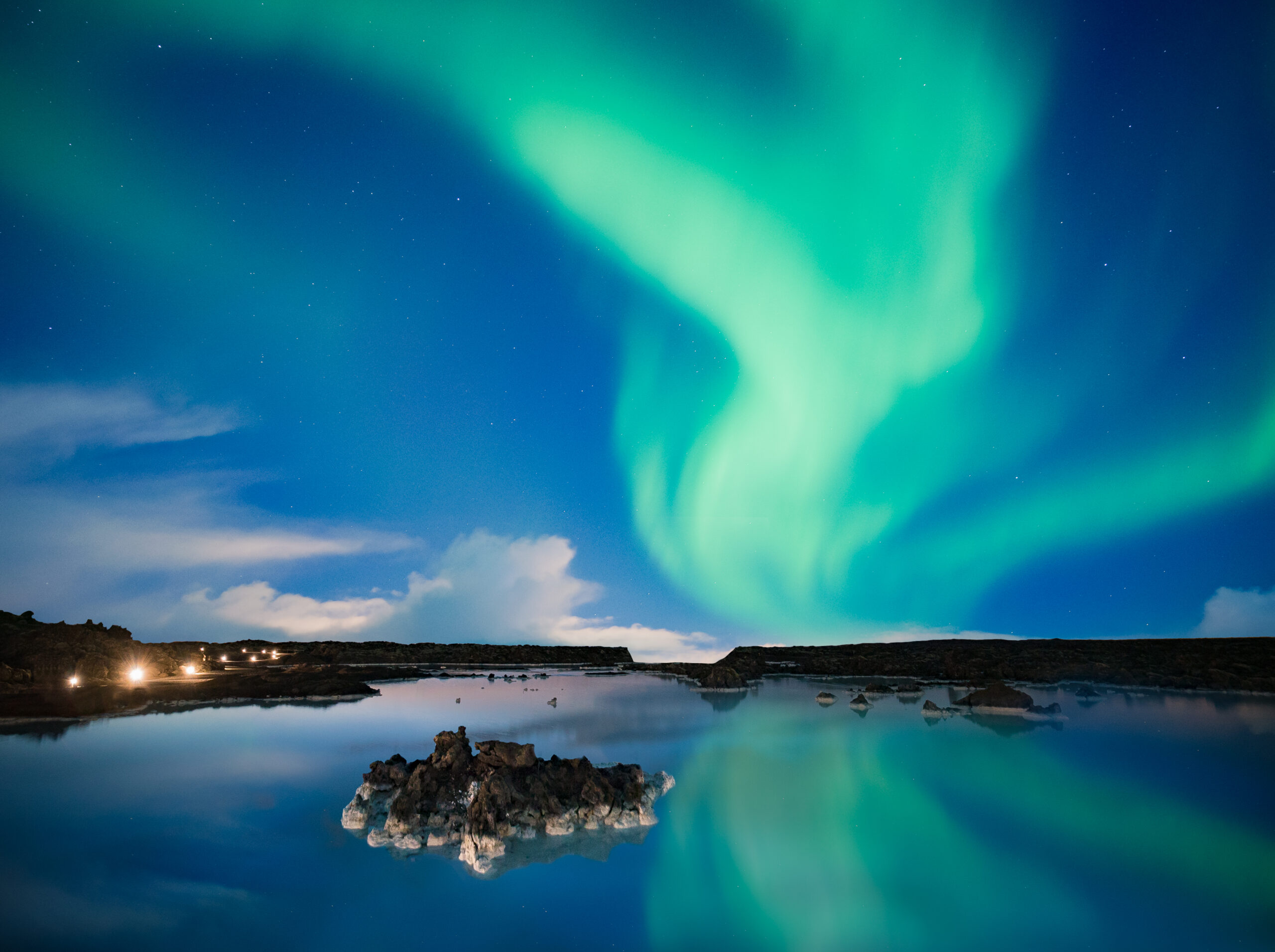
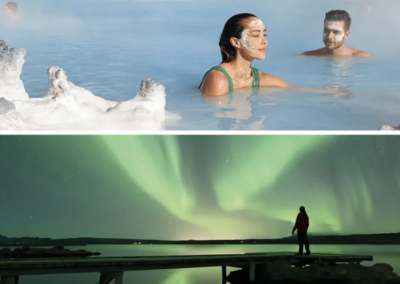
Aurores boréales au-dessus du Lagon Bleu
Rejoignez-nous pour une excursion guidée à la découverte des aurores boréales.
Évitez le stress de la conduite hivernale dans l'obscurité et rejoignez un groupe d'aventuriers partageant les mêmes idées pour une chasse aux aurores boréales guidée.


FAQ about the Northern Lights
Quand puis-je voir les aurores boréales en Islande ?
Pourquoi ne puis-je pas voir d’aurores boréales en été ?
Want to know more about light conditions in Iceland? Check the sun graph and learn about twilight and dusk in Iceland.
What time do the northern lights show up?
During the winter months, when the hours of light are limited, the northern lights can often appear as early at 7:00pm.
As the exact time of an Aurora display cannot be predicted, keep your eyes at the sky. And remember, patience is key!
How long do the northern lights last?
Can I see the northern lights when it is cloudy?
Do the northern lights only appear when it is cold?
Are the northern lights visible all over Iceland?
Are the northern lights really colourful?
The northern lights happen in a variety of colours. Green is by far the most common, but the Aurora can also appear in vibrant shades of pink, purple, red, violet and blue.
To the naked eye though, the northern lights can look quite faint, and at times be perceived as white or grey-ish. This is due to limitations in our night vision.
Camera devices instead can capture a more truthful version of the colours, as, in most cases, it possible to adjust the device settings in order to better adapt to the night time conditions.
Find more about how to improve your night vision and learn how to take great Aurora shots here.
Are the northern lights going to disappear in future?
No, the northern lights are not going anywhere!
The Aurora has been visible in the Arctic for centuries, and that is not going to change any times soon.
What is true is that the solar activity, which is responsabile for the occurrence of the northern lights on our planet, changes over time, following an eleven-year cycle.
During each solar cycle, the Sun goes from a peak to a minimum of activity. During the peak, the so called “solar maximum“, we can expect enhanced activity and, potentially, stronger northern lights visible from unusual latitudes (in the northern hemisphere, this means Auroras being spotted further south than usual). While, during the solar minimum, such unusually strong occurrences become rarer.
Still, at Arctic latitudes the northern lights can be see clearly throughout the whole cycle. And Islande, being well within the “Aurora belt”, is and will remain the perfect destination for northern lights hunting!
What is the BZ value?
The Bz value is part of the Interplanetary Magnetic Field (IMF), which is the magnetic field carried by the solar wind coming from the Sun.
Why does it matter for the Northern Lights? Earth’s magnetic field points north. If the solar wind’s magnetic field (Bz) points south (a negative Bz), it connects with Earth’s field and lets charged solar particles into the atmosphere. This interaction helps create the northern lights. If instead, Bz is positive (northward), the fields don’t connect well, and fewer particles get in — meaning weaker or no aurora.
Think of Bz like an ON/OFF switch: negative Bz (south) = ON, good chance of Aurora soon. Positive Bz (north) = OFF, Aurora less likely.
Learn more about Bz and how the forecast works here.
Which are the best forecast apps and websites for Northern Lights hunting?
Chasing the Northern Lights is all about timing, clear skies, and up-to-date aurora forecasts. These tools help you know when and where there’s a good chance of seeing the aurora — so you can plan your night the smart way. For the best results, we recommend using more than one source, as different forecasts interpret data differently.
WEB FORECASTS
- Official AURORA REYKJAVÍK Aurora Forecast 👉 https://aurorareykjavik.is/aurora-forecast/
Our 6-step expert forecast combines geomagnetic activity, cloud cover, and viewing tips — designed for real-time Northern Lights planning. - SpaceWeatherLive
A detailed global space weather site with auroral activity maps and solar parameters. - NOAA Space Weather Prediction Center (SWPC)
The official US space weather forecast model that many aurora apps base their data on.
TOP MOBILE APPS
- My Aurora Forecast – Offers real-time KP index, global aurora maps, push alerts and multi-day forecasts — great for travelers and serious aurora watchers alike.
And don’t forget to unable notifications, so you’ll get alerts when aurora activity spikes.
📍App Store
📍 Google Play
By following this guide, you’ll be well-prepared to experience one of nature’s most magical displays. Whether you’re planning your trip or already in Iceland, the Aurora awaits!